30 July 2026 is Earth Overshoot Day for this year. As mentioned in the post during the COVID19 pandemic when earth overshoot day was pushed to 22 August 2020 due to the restrictions of lockdown:
Earth Overshoot Day marks the date when humanity has
exhausted nature's budget for the year. For the rest of the year, we are
maintaining our ecological deficit by drawing down local resource stocks and
accumulating carbon dioxide in the atmosphere.
The result of overconsumption, extractive policies, overexploitation of resources, use-and-throw lifestyles, linear instead of circular economies and of course unsustainable development.
Perhaps there is a message that Earth Overshoot has been falling in July, a month observed as "Plastic Free July" centering a RE-Plastic (REplacing, REducing, REcycling & REusing Plastic) Lifestyle. Eschewing the throwaway (single-use/disposable/wasteful) culture will go a long way in extending natural resources longer into the year - thus delaying our dependence on resources of future years and generations.
Illustration Credit: Global Footprint Network 2026,
www.overshootday.org and www.footprintnetwork.org
With wars in multiple parts of the world literally burning through resources explosively, it seems counterintuitive that earth overshoot day is nearly a week later this year. While we would tend to pat ourselves in the back that last year's earth overshoot day fell on July 24th 2025 and in the Fire Horse Year 2026 it has been pushed back almost a week to July 30th 2026, it must be noted this is just an accounting correction due to "upward data revision in the Ocean Carbon Absorption" rather than significantly improved resource conservation and ecological restoration (see image below for AI summary of why this stretch happened):
See more at: https://overshoot.footprintnetwork.org/newsroom/country-overshoot-days/
If the whole world lived like Indians , we won't overshoot the earth's budget of annual ecological resources, see this DWTV's coverage of Earth Overshoot Day 2025:
Data Revisions: Upward adjustments to ocean
carbon-absorption metrics and minor account updates shifted the baseline
calculation 8 days later.
Real-World Change: Actual rising human consumption
widened the ecological deficit, pushing the date 2 days earlier.
Net Effect:
Combining the +8 day data correction and -2 day consumption acceleration
resulted in the net 6-day calendar delay.
True Trajectory: Despite the later
calendar date, resource consumption pressure worsened, making 2026 the highest
state of ecological overshoot to date.
As mentioned in the DWTV report, less waste, more recycling, reducing food waste, overconsumption and shifting to green energy all will help push back Earth Overshoot Day.
Thus centering a Circular Economy model, slow fashion, zero-waste, Net-Zero eco-conscious lifestyles - Sustainable Development - will make us live within our planetary resource budget. This way of life itself is Climate Action - SDG 13 as the ecological footprint and carbon footprint of our lives shrink. This is much needed in a world bearing the brunt of climate change.
It's easier said than done as there are entrenched systems that pushback on changes in consumption patterns. This video by creator AliMcForever "Burning Carbon" explains it succinctly:
Here's to hoping that we can shift to a more ecologically conscious and environmentally freindly way of life thus living within our planetary resource budgets!
In the news: an Extreme Heat event at London Climate Action Week (June 20-28, 2026) was cancelled due to Extreme Heat! If that isn't a scream for Climate Action (SDG 13) from our fast warming planet due to our actions I don't know what is!
First World Problems Lead to Action
Europe and North America's infrastructure is geared towards surviving winters rather than facing extreme heat and heatwaves in summer. As our climate crisis was in large part a legacy of the Industrial Revolution and industrialization originating in the First World (read: UK, Europe and USA and Canada,... Japan not so much!), climate action there and a policy shift towards a circular economy model will boost sustainable development and climate adaptation like nothing else.
Just as urban centers are perceived as the loci of effective climate action and climate policy locally and nationally, globally the First World - the Developed Countries are seen as climate action and more importantly climate finance hubs.
Talking long term, Spain's transition to solar energy with massive investment on revamping its grid to accommodate electricity generated from renewable sources is a huge win for climate action. Barcelona's affordable and climate smart housing is a great example of Climate Action and Just Transition. Spain is a bit of a poster child of climate action and just transition as it has long been facing extreme weather events (forest fires, flooding, heat waves) and economic crises which it has through recent policy sought to tackle together - sustainable development and just transition - climate justice for all!
Germany and the UK demolishing and retiring their coal-fire/thermal power plants also massively cut their carbon footprint. The growing contribution of renewable energy in American, British and European is both about energy security (while war rages in regions producing and in shipping routes of fossil fuels) as well as climate action through putting climate policy into practice.
Germany's super efficient waste recycling system (Gruener Punkt system since 1990) is another great example of the circular economy and success stories of both Responsible Production and Consumption (SDG 12) and SDG 13.
How India Beats the Heat
Tamil Nadu's Cool Roof Initiative promoted by UNEP award-winning TN Environment Secretary Supriya Sahu as well as a growing chain of climate-proof rest hubs for gig workers across India as well as insurance for income lost due to extreme weather are some concrete actions to tackle extreme heat across India.
The cool roof initiatives - painting the roofs with reflective weather-sheild white coating cools the temperure up to 5 degrees and is getting popular in lower income urban islands across India. It's a Just Transition win.
Reclamation and restoration of water bodies across India and Miyawaki Forest planting across urban India also counters the Urban Heat Island effect. But there initiatives are few and far between.
Heat Action Plans and Heat Emergency Rooms in place also tackles emergency situations that arise across Indian Summers both in northern dry heat hubs and southern hot and humid regions.
The Climate Crisis Discriminates
Climate Action Now
Climate Justice & Just Transition
On 1 June 2026 Global Parents Day (though India & US
celebrate Parents Day on 26th July - 26-7-26) was observed. As the climate crisis triggers extreme weather it puts older parents at risk and young people are actvely rethinking actually becoming parents.
Thus climate action like curbing individual, family, community and national carbon and ecological footprints is a great step forward.
As mentioned many times on this blog since January 2019, you can calculate your carbon footprint and work out how to adopt an ecofriendly lifestyle with Only Planet.
A sustainable mode of transport is a great place to start and the fact that World Bicycle Day was observed on 3 June 2026 with the theme: “Cycling for a Greener
Future” is another obvious hint from the universe to adopt a sustainable way of life.
In a bit of good news the fact that Earth Overshoot Day is nearly a week later in 2026 than in 2025 is an indicator of a small step to responsibly use the planet's resources. Its on 30 July 2026 where last year we began living on borrowed resources on 26 July 2025 itself.
The month of June while observed as Orca Awareness Month (All About Killer Whales) otherwise has an enhanced focus on the ecosystems that support the biodiversity that's celebrated through May.
Between World Bicycle Day (June 3rd, "Cycling into a Greener Future," 2026 theme), Environment Day (June 5th), Ocean Day (June 8th), International Day to Combat Desertification and Drought (June 17th), the Summer Solstice (also observed as Yoga Day, where Surya Namaskar a.k.a. Sun Salutations from India in the Northern Hemisphere is vital to the ancient practice and the sun too reaches its exaltation over the Tropic of Cancer running through the heart of India with two Sun Temples in the East and West along the latitude), and Rainforests Day (June 22nd), the focus is firmly on the ecosystems and environment that supports life and livelihoods.
The time is now. Action is necessary urgently as security risks abound in India, South Asia and beyond due to climate change and the heating planet supercharging weather phenomena such as the El Nino. The UN Secretary General Antonio Guterres himself took time out to mention the impending climate disasters likely triggered by the Super El Nino as warned by the World Meteorological Organization:
While our Sustainable Development Goals (SDGs) are environment coded, protecting our planet in the quest to truly progress is all about putting people, planet, progress and profits in the same page of the plan of action.
Inclusive plans of action and an intersectional lens are vital features of true environmentalism. The effects of the climate crisis are gendered and classist hence the process of protecting our environment needs to voices of women, girls, minorities and the marginalized, with a responsive ground up, grassroots grown approach.
For Our Future
Nations are institutions are doing quite a bit to protect our environment "for our future," but a lot more needs to be done.
The pace of destructive activity and our crude oil addiction outpaces conservation and restoration efforts and the mainstreaming of renewable energy sources.
Ecofeminism is needed as the growth model now more than ever. Gender Equality (SDG5), Reduced Inequality (SDG10) and Peace, Justice and Strong Institutions (SDG16) are all vital to Climate Action (SDG13) and the path to Just Transition and robust environmentalism.
Meanwhile, as an individual, this environment day and beyond you can track your personal carbon footprint (Check out OnlyPlanet.in) and find means to shrink it to reduce your impact on the environment in order to protect it ... for our future. For, to quote the immortal Jane Goodall,
"Every single one of us makes an impact on our planet every single day and we can choose what kind of impact we make."
The theme for 2022 International Women’s Day, observed
globally on March 8, is spot on:
“Gender equality today for a
sustainable tomorrow.”
As I was pondering over this post yesterday before I learnt
about the theme, I thought up the title. Empowered women are the heart and at
the heart of Sustainable Development and Gender Equality, SDG 5 is vital if the
Global Goals are to be respectably reached by 2030.
— Raakhee Suryaprakash (@10sunshinegal) March 8, 2022
Every sustainable development goal (SDG) becomes effective
if it is gender just. It’s a theme I regularly harp on – educated girls and
empowered women are the building blocks of a sustainable community. The crucial
steps needed to offset the patriarchy which is the main stumbling block to sustainable
development.
Even as I sat down to write this post, I received a mail
from Black by ClearTax, the platform I use to file my IT returns, citing their data
analysis of investment pattern which shows that against stereotype, women are
investing 12.7% more than men on average. This statistic resonates with social
media trends that’s replete with examples of posts, reels, short videos and
viral content of women advising women on finance and investment putting
financial security at the heart of women’s empowerment.
From women-majority Self Help Groups, women-led and
women-majority panchayat institutions to women’s financial services such as Mahila
Bank (e.g., Chetna Gala Sinha, who established the women's rural
banking institutions, Mann Deshi Mahila Sahakari Bank) to women entrepreneurs–focused online platforms such as SHEROES, for
women-by women angel investing, and initiatives such as Feminist Approach to Technology, feminist city planning and Feminist Foreign Policy being adopted by some nations can jumpstart gender equality in the
micro and macro levels as well as locally and globally.
One of the low hanging fruits of international aid is
packages for training and funding women entrepreneurs. It is as popular as
educating girl children as a strategy for poverty alleviation and social
upliftment through women’s empowerment. Yet access to funding and support to
women-led initiatives is still unequal. Networks of women within institutions
and MNCs, locally, nationally and internationally are helping close this gap,
e.g., Sakhi (Accenture India), Wsquare, National Alliance of Women’s Organisations
(NAWO, UK), Vital Voices, SHE Changes Climate, Lean In, Shevolve, etc. Crowdsourced
maps and resources such as that of the Red Dot Foundation and the Red Elephant
Foundation (the GBV Help map and the Saahas app) are equally vital is ensuring
security and empowering women.
As mainstream media frenziedly covers the war in Ukraine
ignoring and downgrading other vital issues, observances such as International
Women’s Day, World Wildlife Day (March 3rd), World Water Day (March
22nd) will shift the narrative at least temporarily. The events of
the 66th session of the Commission on the Status of Women (CSW22)
scheduled from March 14 to March 25, 2022, will also help keep the focus on
gender mainstreaming and the Women, Peace and Security (WPS) agenda.
From poverty alleviation to tackling climate change and building the economy and strong institutions and international partnerships for progress all require a gender just and feminist approach.
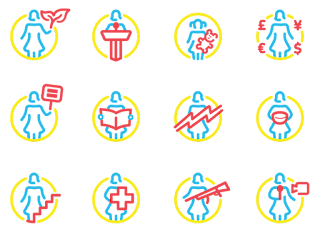
The 12 critical areas of concern of the Beijing Platform for
Action along with Gender Just Sustainable Development are the perfect
guideposts and milestones to aim for in the path to empowering women and
achieving Gender Equality. They are as follows:
Women and the environment
Women in power and decision making
The Girl Child
Women and the economy
Human rights of women
Education and training of women
Violence against women
Women and poverty
Institutional mechanisms for the advancement of women
It's a new year, and as Lord Alfred Tennyson put it "Hope smiles from the threshold of the year to come,
whispering, 'It will be happier'." Even as the Omicron variant of the pandemic that has plagued us from the beginning of this decade brings the world to its knees, hope persists that this year will be better for people and the planet and equally importantly for the planet's flora and fauna (biodiversity). Sustainable development and a circular economy approach is vital to revive the global economy battered by Covid and the Climate Crises in a sustainable manner.
The path to sustainable development is through adopting the circular economy model and closing the wasteful Take-Make-Waste production model. In a Circular Economy, systems are regenerative and integrative. The waste of one product becomes the raw material for another to close the loop. To adopt it and make the current requires systems thinking change as well as a change the operating system of the global economy and make it less wasteful.
To allow climate action and if we are to achieve the net-zero ambitions anytime, let alone by 2050, SDG12 - responsible production and consumption - must be top priority. This allows for processes to cut their carbon emission and reduce the ecological footprint of products and industries to avoid Earth Overshoot and keep within the planetary boundaries.
You can get a fuller explanation of Circular Economy from this Systems Innovation video:
There is an urgent need to stay within planetary boundaries of resources to avoid extinction level events and biodiversity loss. Beyond personal carbon footprint to community, industry, regional and national footprints as building blocks to keep within planetary boundaries. Already new estimates and studies indicate that we have already passed the safe limit for chemical pollution and plastics production, consumption and waste after single use are major culprits.
This is big and bleak news. The planetary boundary for chemical pollution (aka 'novel entities') has been quantified for the first time - and it's now clear that humanity is massively transgressing levels that are safe for life on Earth. Plastics! Read on. https://t.co/OEHWdSOX23pic.twitter.com/lAwgRG0y3G
You can read the full Twitter thread on the planetary boundary for chemical pollution (and the plastic effect) here. Food waste co-existing with millions of hungry people is another symptom of our wasteful economic system and it has to be addressed urgently to end world hunger (SDG 2), food-related lifestyle diseases, and provide the necessary nutrition for good health and well-being (SDG 3). Ensuring SDG12 and circular economy in the agricultural-agribusiness-food sector also ensures that this major contributor to greenhouse gas emissions and deforestation is put in check ensuring climate action now (SDG 13). The catchy and information filled Food Waste Song from Australian Tik-Toker and comedian Benny Davis shows the way.
There is wastefulness everywhere and the current system churns out emissions and pollution at every stage. Even as individuals and concerned consumers and citizens take action to reduce their personal carbon footprint, we hear of the sheer wastefulness from certain sectors and the super-rich and the powers-that-be. Take for example: Fast fashion trash is piling up in Chile's Atacama Desert where it is disposed and luxury brands are burning and shredding product rather then sell it cheap. They all continue to manufacture products unchecked but control supply and create artificial scarcity by wasteful methods to increase prices and the desire for the perceived "exclusive" products among their super-rich and wanna-be [rich] customers. Another example is news of airlines flying empty flights (ghost flights), emitting tons of emission without benefitting any traveler just to maintain their airport slots during the pandemic caused international flight bans. The sheer carelessness of the sector when the climate conscious are cutting down their use of flights (flygskam - flight shaming) and even giving up flying as a mode of travel. When you hear such news about ghost flights, world leaders and business leaders summit hopping in private jets, and billionaire space races, one feels flygskam aimed at the average citizen is a bit of a scam.
This is the time of the year for the World Economic Forum (WEF) at Davos, where the movers and shakers of the world rub shoulder and maintain the status quo by setting and shaping the world to suit their agenda. This year, for the second time consecutively because of the pandemic WEF is being held virtually thus cutting the event's carbon footprint. This crisp review of the book Davos Man: How the Billionaires Devoured the World also spreads the blame to the millions of consumers who fund the billionaire lifestyles. We are trapped and manipulated by convenience and brain-washing into choosing to make them richer exceeding our personal budgets and planetary boundaries for resources.
Yet there is power is personal choice and collective action. Consumer and citizen power collective action all about personal choices can offset billionaire effect so act to reduce your personal carbon footprint and get others to do the same. Let us not allow what happens in Don't Look Up to become our permanent reality vis-à-vis the climate crisis. Give the Global Goals a chance to bolster the future outlook. Truly build back better. An opportunity to survive and thrive amid the existential pandemic threat. that is pressurizing us now.
Tracking and cutting your personal carbon footprint and getting others to do it too and adopt a sustainable lifestyle can make a huge difference.
In this the second year of the UN Decade of Ecosystem Restoration (2021-2030) buffeted by COVID and Climate Catastrophe, there is an urgent need to Invest in our Planet. Perhaps it is apt that this [Invest in Our Planet] is the theme for Earth Day 2022 (April 22). The need for an Earthshot (named after another world-changing project - the Apollo Moon
landings, nicknamed Moonshot. They helped advance mankind's technological
achievements and ... help improve life for
everyone).
Sustainable habits, citizen action to make communities sustainable (SDG 11: sustainable cities and communities), grassroots approach to ensure sustainable development and circular economy is the path to climate action and economic recovery (SDG 8) in our current reality (COVID-19 + Climate Change).
Composting, homesteading, buying local and direct from farms and gardens, promoting regenerative systems and agriculture, choosing energy independence through renewable energy sources, rain water harvesting and grey-water recycling for water security at family, community and city levels, building community gardens and food forests, saving the soil and seeds thus building a community of active citizens who work to bring forth climate-friendly and eco-friendly policies and politicians is a great continuum for planet- and people-friendly change. Using personal consumer, citizen and community power to invest in the planet is my hope for 2022 and beyond. It is an expressway to the global goals and achievement of sustainable development through creation of circular economies.
The big deal in October 2021 includes two environmental conference of parties (COP) separated by the first ever Earthshot Prize ceremony and the International Day of Climate Action.
Between the two avenues for rhetoric the finalists and winners of Earthshot Prize with their innovative solutions for the problems that plague our planet offer hope in this the first year of the UN Decade of Ecosystem Restoration. They are icons to be celebrated o f the Day of Climate Action and beyond in order to bridge the climate rhetoric-climate reality divide.
The first COP to occur in October was the first part of the Biodiversity COP15 that took place online between October 11th and 15th, online among the parties to the Convention on Biological Diversity. With China as chair, this was a forerunner to the second-part of the COP15 - the in-person session scheduled to happen in Kunming between April 25th and May 8th 2022. With the Chinese premiere giving the Climate COP in Glasgow beginning on Halloween 2021 a miss, this Biodiversity COP15 was where China flexed its environmental muscle. With the 6th Mass Extinction and immeasurable and irreplaceable biodiversity loss being part of our reality, made worse by the nightmare of the climate crisis manifesting the world over with particularly devastating effects in the poorer, island, coastal and tropical parts of the world, the need to act to protect biodiversity and address climate change is existentially vital. Thus it makes sense that in between the two COPs on October 19th, the million-pound Earthshot Prize ceremony to honor the 5 climate heroes - Eco-Oscars as it were, was hosted by the Duke and Duchess of Cambridge in Alexandra Palace, in London. This competition for the Royal Foundation's five million-pound prizes was launched mid-pandemic in 2020 by Prince William to give Earth a shot in the arm and address five critical issues and the five winners addressed these innovatively and effectively
(1) 'the
restoration and protection of nature' - Costa Rica, (2) 'air cleanliness' - Takachar, India (3) 'ocean revival' - CoralVita - Bahamas, (4) 'waste-free living' - The Food[Waste] Hubs of the City of Milan, Italy & (5) 'climate action' - Hydrogen producing Enapter's AEM electrolyser (Thailand, Germany, Italy).
Key takeaways from the Online UN Biodiversity COP15 include world leaders acknowledging certain facts but not taking much action:
(1) As Nature's Decline Threatens Humanity, We Must Work to Reverse Biodiversity Loss; (2) Post-2020 Global Biodiversity Framework: Understanding the Scope and Scale of the Biodiversity Crisis; (3) Kunming Declaration - a commitment to protect 30% of land and sea area by 2030 [30-30] (4) Gap between promises of biodiversity protection and any real or effective climate action (5) Need for Global Biodiversity Fund. The difficulty in actually achieving the much needed 30-30 protection in the face of so-called "economic realities" - the pandemic-fuelled global economic slowdown and resultant domino of energy crises and economic crisis that put environmental crises on the back burner even though it costs nations billions of dollars they can't afford.
Case in point, according to a World Meteorological Organization report, the natural disasters in 2020 cost India $87 billion, i.e., ₹65 Lakh Crores.
As I predicted in my article for the Chennai Centre for China Studies (C3S) in September, not much can be expected from COP15 in the face of geopolitical and human security concerns. The main agenda of COP15 included positioning China as an environmental force to be reckoned with, showcase of Chinese success stories in biodiversity protection and its Red Line Plan as well as paving the way for a much-needed multi-billion dollar Global Biodiversity Fund even though it will take a long time for countries to make and honor these commitments.
With these gaps in rhetoric and reality in mind, perhaps it becomes clear why the International Day for Climate Action 2021, October 24th, doesn't have the same prestige or reach of say Earth Day or Environment Day. The Fridays for Future movement is more impactful. and in a way as long as there is real climate action, it doesn't really matter if we celebrate the Day of Climate Action widely or not! And this is where it is hoped that the Climate COP26 to be held in Glasgow between October 31st and November 12th will make a dent in ensuring that world leaders and corporations commit to climate action and limiting carbon emissions. The real scary thing on Halloween 2021 will be the cost in emissions and money that the world is spending on what many believe is an eye-wash of a "greenwashing" conference hoping for a better outcome!
So ahead of COP26 here's a checklist to keep in mind while assessing the Climate COP26 that begins on Halloween:
Now let's get into the specifics. @climate's set out the priorities for what to look out for at #COP26.
1. Higher commitments from countries 2. Rules for a global carbon market 3. $100 billion in finance for developing countries 4. Reducing coal use 5. Reducing methane emissions
August 22, 2020 is both Madras Day locally and Earth Overshoot Day globally. As the coastal metropolis, Chennai formerly known as Madras celebrates its 381st birthday, the COVID19 pandemic's global lock down and quarantines has pushed the Earth Overshoot Day by 24 days to August 22nd.
Earth Overshoot Day marks the date when humanity has exhausted nature's budget for the year. For the rest of the year, we are maintaining our ecological deficit by drawing down local resource stocks and accumulating carbon dioxide in the atmosphere.
The coronavirus that affects the respiratory system of living things has affected the global transportation infrastructure disrupting supply chains and reducing human consumption. At the start of the pandemic there were many stories of wildlife reclaiming urban spaces and hope of our earth's environment healing and climate stabilizing. The disruption of aviation, shipping and transport sectors had reduced the fossil fuel consumption as well as generally resource intensive products. Local suppliers and locally grown food have addressed the shortfall.
Yet for all the disruption to our lifestyles and the economy our consumption still outstrips our planet's resources by a whole quarter. So the priority as we envision the post-COVID19 world is to be responsible and sustainable in our consumption and production (SDG12) so that we #MoveTheDate of Earth Overshoot Day to the year end. Thus we stop borrowing and living off the resources of future generations:
As Chennai celebrates 381 years a future as a Sustainable City, Sustainable Community (SDG11) as well as a Smart City needs to adopted. Chennai's coastal position, expansion eating into vital wetlands, and dependence on ground water we are vulnerable to the buffets of global warming, climate change and climate catastrophe. The flood-drought cycles, unbearable summers in urban heat islands, creeping salinity as well as seawater ingress are vicious byproducts locally of global over-consumption which calls for robust climate action (SDG13). Chennai's green spaces as well as incentives and interests urban and rooftop farming as well as the Tamil Nadu's wind energy harnessing successes are powerful manifestations of sustainable development.
Hence in the quest to move the date of Earth Overshoot Day should make robust adoption of the sustainable development goals (SDGs) by all entities from cities, institutions to nations.
On World Water Day, observed on March 22nd annually, the theme this time #WorldWaterDay20202 explores the connection between #water and #ClimateChange.
In terms of the sustainable development goals #SDGs, this year's theme for #WWD2020 brings into focus both #SDG6 & #SDG13 - Clean Water and Sanitation as well as #ClimateAction respectively.
An event I attended in Chennai on March 7, 2020, Eco-fest 2020 showcased experiments and edu-tainment by school students from the to highlight ecology and environmental issues of the city. The street play that they put up in particular linked the need to revive the lifeline of the city the River Adyar by increasing the tree cover in the watershed area of the river as well as restoring and replenishing the many water bodies, in Tamil "eri" as well as ponds and temple tanks that feed the river as well as the water table. As climate change gets to work worsening the weather patterns and natural systems of Chennai as well as India and other climate frontline states, water stress and flood-drought cycles will become the norm that will affect the millions of people living in the vulnerable regions. This climate changed charged has the potential to kill, sicken and impoverish millions if not tackled ASAP.
The Street Play put up by "சுற்றுச்சூழல்
நாடக சபா" [Environmental Drama Club] in keeping with the tradition of street plays in Tamil Nadu known as Therukuthu (தெருகூத்து) had a mythological theme with bright costumes and brash monologues by a narrator who regularly interacts with the audience. The narrator/common man in this play stole the show as he jumped and exclaimed along and showcased ecological mythic play.
In order to incorporate the environmental theme they linked the myth of the Demon King (Asura) Padhmasura who was granted the boon of burning down anything he puts his hand over by the Lord Shiva (the Divine Destroyer) who was finally destroyed by the Divine Protector Lord Vishnu in the guise of the beautiful nymph Mohini problems of the city's water stress and the polluted Adyar River, the reduction of clean water sources in the river due to an ecologically devastated water shed area with abounding with deforestation and usurping and polluting of water bodies. Characters such as the Earth Goddess (Bhoomi) and the Water God (Varuna) as well as the Forest Goddess/nymph to spread the message of water conservation and afforestation to ensure a water positive Adyar Watershed Area made for a very entertaining and educative evening for us all.
The photo-booth captured the essence of the city's ecology while the shadow puppetry by the class 6 students of the host school Vidyaniketan was amazing highlighting the source and effects of global warming and climate change. The shadow puppet plays brought out the plight of the Ennore Creek because of the thermal power station in the region as well as the industrialization of that ecologically sensitive area in the north end of the city. The link between coal-powered fossil fuel plants like the one polluting Ennore Creek was also succinctly shown. The impact of climate change and global warming increasing forest fires, floods, droughts and biodiversity loss was also showcased in the short presentation.
So well done and kudos to the kids, their teachers and the playwrights and craftspersons...all excellent communicators for the cause of our ecology. The young and committed resource persons of the Pitchandikulam Forest Community (PFC) have been adding immense value to the environmental studies component of schools in Chennai. Their outreach and restoration efforts in the city has improved the city's environment and environment education. They have been involved with the creation of Adyar Pooga in the estuary area of the Adyar River as well as in conducting informative Adyar river walks from Chembarrambakkam reservoir to the river mouth on Elliot's Beach emptying water into the Bay of Bengal past revived mangrove islands in the river flowing past Theosophical Society's Adyar HQ. The impact we have on the river and the river's importance to sustaining and safeguarding the city and its biodiversity was made clear in both Adyar Poonga and Adyar River Walk by the informative exchanges with the PFC resource persons.
On World Water Day (March 22nd) and World Forest Day (March 21st) that just preceded it, as we focus on the connections between water and climate change as well as forests and biodiversity in our water stressed, fossil fuel guzzling and carbon emitting cities, efforts like that of PFC to educate and restore goes a long way in healing Mother Nature.
As we deal with the effects of the Coronavirus pandemic on our lives, lifestyles, livelihoods, economy and ecology, the importance of clean water and sanitation in protecting us from outbreaks and leaving forests pristine and untouched and biodiversity protected are all reinforced. Be it water and climate change or forests and biodiversity, it is in our interest, a matter of survival of our species, to live lightly and protect nature and her resources.
The theme for World Soil Day 2019 is "Stop soil erosion, Save our future."
This day promoted by the Food and Agriculture Organization (FAO) has, since 2012, hoped to raise awareness about the role healthy soil plays in "sustaining healthy ecosystems and human well-being." Ensuring "Good Health and Well-Being" #SDG3 as well as life on land #SDG15 can be achieved through healthy soil that produces healthy food and healthy people. Tending the soil can improve mental health and well-being. Thus the process of ensuring soil health - organic gardening and organic farming can ensure mental health. Healthy minds are vital for people to thrive.
As the member-states of the United Nations gather in Madrid at COP25 to discuss climate change, reports submitted there indicate that land degradation is a major driver of climate change.
Now while it's important to de-carbonize our economies and "Keep Oil in the Soil and Coal in the Hole." A major way that people and policy can help curb emissions and environmental degradation is by curbing soil erosion and restoring and rejuvenating the soil. Intensive organic agriculture and mixed agriculture especially cultivation amidst man-made mixed fruit forests or rice fields that farm fresh water fish in fields can help restore soil.
These fields of trees can provide shade on a hot day, fix soil and protect it from erosion as well as fixing water and carbon. The leaves that fall from them can bring in nutrition and organic matter to improve soil. This is permaculture harnessed to horticulture and agriculture underpinned by chemical-free organic restorative and regenerative cultivation practices. Agroforestry demonstrated by young Costa Rican farmer Alexander Retana, shows that we can increase green cover and produce food comfortably.
As Vandana Siva put it in the Year of the Soil in 2015 when we saw the signing of the Paris Climate Treaty, "we are nothing without living soil. ...If we make peace with the soil we make peace between people."
As the article in the Hindu Business Line indicates
In short, deforestation, which in itself raises carbon emissions by 25 per cent, along with all human activities pursued on the land, is the real cause of climate change in the form of extreme weather conditions like intense and untimely rains, floods, soil erosion, and high temperatures.
Our lifestyle, the food we eat and from where we source it has an impact on the life of the planet and its soil. Unsustainable agricultural practices, industrial agriculture, deforestation caused by greed for more agricultural and grazing lands (Amazon and the Equatorial Rainforest in Southeast Asia being two key examples of vital primordial forests cut down or burnt down).
Ecological farming - restorative organic farming that puts organic matter back into the soil to keep it living instead of making a zombie out of it with petrochemical fertilizers and pesticides, can be the difference between life and death of the soil and of the human race.
We need to #StopSoilErosion in all its forms and unsustainable agricultural practices and unsustainable development are key reasons for dying soil.
In a world where micro-hunger - the hunger for essential nutrients is as devastating to a different set of people as hunger is to the poorer populations, ensuring that the soil is healthy ensures that there is Zero Hunger #SDG2. Nutritious food can be produced through healthy and nutritious soil. Saving the soil can ensure that all the sustainable development goals are achieved. Smallholder farmers in the developing world must be engaged in preserving and restoring soil health. Making young farmers,women farmers, and small-scale farmers - usually marginalized and impoverished by industrial agriculture - should be made stakeholders who can benefit from ecological farming that restores soil health and ensures soil is safe from erosion. Organic ecological agriculture can be incorporated into climate adaptation and climate action measures that can be funded and trained by climate finance and green tech transfer. These marginalized farmers can help #SaveOurFuture by saving the soil. Thus we can ensure social justice and climate justice by protecting soil.