Showing posts with label Adyar Poonga. Show all posts

Friday, 21 August 2020

Earth Overshoot Day 2020 is Madras Day 2020: August 22


August 22, 2020 is both Madras Day locally and Earth Overshoot Day globally. As the coastal metropolis, Chennai formerly known as Madras celebrates its 381st birthday, the COVID19 pandemic's global lock down and quarantines has pushed the Earth Overshoot Day by 24 days to August 22nd. 


Earth Overshoot Day marks the date when humanity has exhausted nature's budget for the year. For the rest of the year, we are maintaining our ecological deficit by drawing down local resource stocks and accumulating carbon dioxide in the atmosphere.

 The coronavirus that affects the respiratory system of living things has affected the global transportation infrastructure disrupting supply chains and reducing human consumption. At the start of the pandemic there were many stories of wildlife reclaiming urban spaces and hope of our earth's environment healing and climate stabilizing. The disruption of aviation, shipping and transport sectors had reduced the fossil fuel consumption as well as generally resource intensive products. Local suppliers and locally grown food have addressed the shortfall. 

Yet for all the disruption to our lifestyles and the economy our consumption still outstrips our planet's resources by a whole quarter. So the priority as we envision the post-COVID19 world is to be responsible and sustainable in our consumption and production (SDG12) so that we #MoveTheDate of Earth Overshoot Day to the year end. Thus we stop borrowing and living off the resources of future generations: 

https://www.facebook.com/2040Film/videos/2583969951914239


As Chennai celebrates 381 years a future as a Sustainable City, Sustainable Community (SDG11) as well as a Smart City needs to adopted. Chennai's coastal position, expansion eating into vital wetlands, and dependence on ground water we are vulnerable to the buffets of global warming, climate change and climate catastrophe. The flood-drought cycles, unbearable summers in urban heat islands, creeping salinity as well as seawater ingress are vicious byproducts locally of global over-consumption which calls for robust climate action (SDG13). Chennai's green spaces as well as incentives and interests urban and rooftop farming as well as the Tamil Nadu's wind energy harnessing successes are powerful manifestations of sustainable development.   


Hence in the quest to move the date of Earth Overshoot Day should make robust adoption of the sustainable development goals (SDGs) by all entities from cities, institutions to nations.

Sunday, 22 March 2020

Water and Climate Change: World Water Day 2020

On World Water Day, observed on March 22nd annually, the theme this time #WorldWaterDay20202 explores the connection between #water and #ClimateChange. 


In terms of the sustainable development goals #SDGs, this year's theme for #WWD2020 brings into focus both #SDG6 & #SDG13 - Clean Water and Sanitation as well as #ClimateAction respectively. 
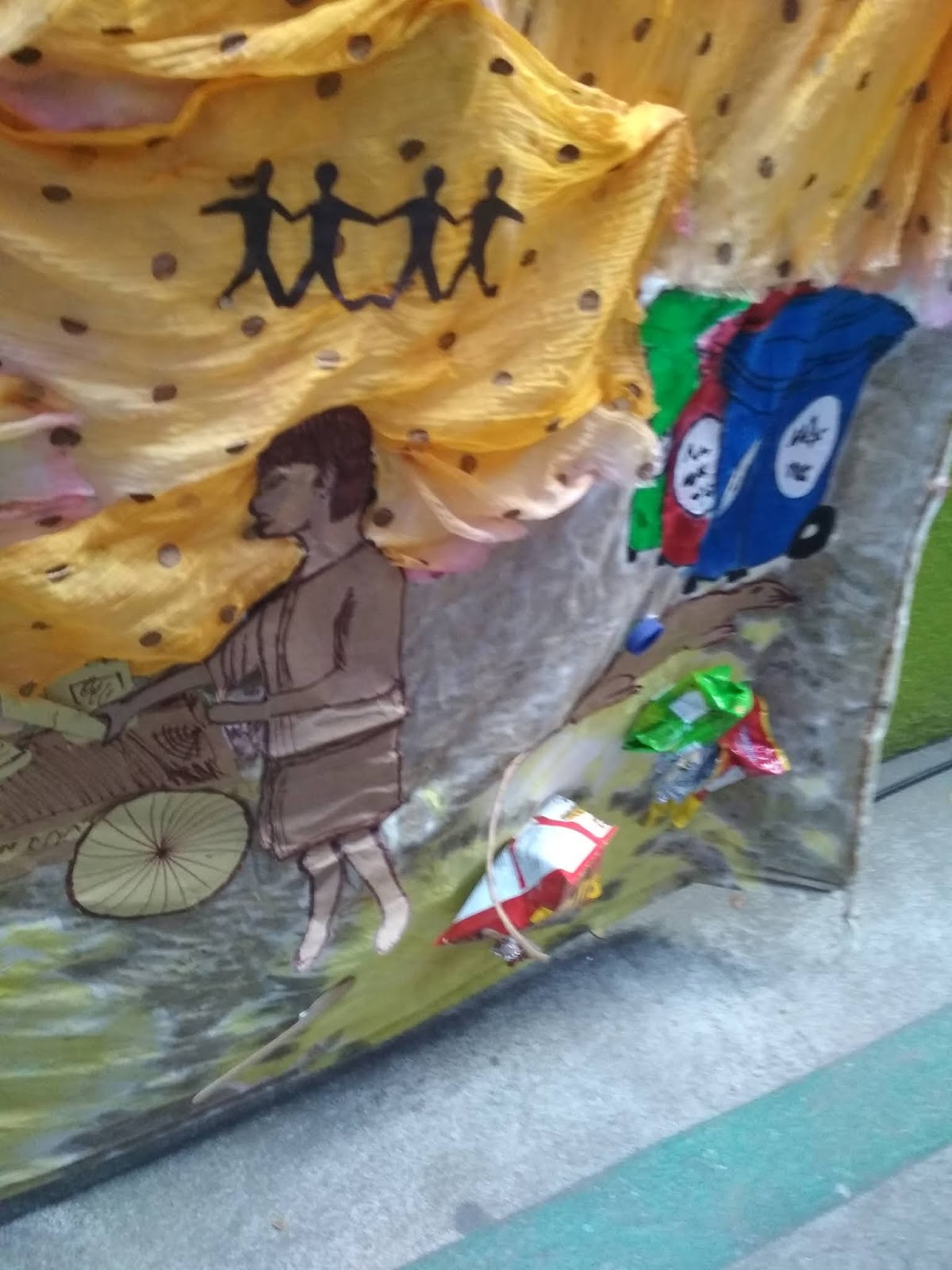
An event I attended in Chennai on March 7, 2020, Eco-fest 2020 showcased experiments and edu-tainment by school students from the to highlight ecology and environmental issues of the city. The street play that they put up in particular linked the need to revive the lifeline of the city the River Adyar by increasing the tree cover in the watershed area of the river as well as restoring and replenishing the many water bodies, in Tamil "eri" as well as ponds and temple tanks that feed the river as well as the water table. As climate change gets to work worsening the weather patterns and natural systems of Chennai as well as India and other climate frontline states, water stress and flood-drought cycles will become the norm that will affect the millions of people living in the vulnerable regions. This climate changed charged has the potential to kill, sicken and impoverish millions if not tackled ASAP. 
The Street Play put up by "சுற்றுச்சூழல்
நாடக சபா" [Environmental Drama Club] in keeping with the tradition of street plays in Tamil Nadu known as Therukuthu (தெருகூத்து ) had a mythological theme with bright costumes and brash monologues by a narrator who regularly interacts with the audience. The narrator/common man in this play stole the show as he jumped and exclaimed along and showcased ecological mythic play. 
 In order to incorporate the environmental theme they linked the myth of the Demon King (Asura) Padhmasura who was granted the boon of burning down anything he puts his hand over by the Lord Shiva (the Divine Destroyer) who was finally destroyed by the Divine Protector Lord Vishnu in the guise of the beautiful nymph Mohini problems of the city's water stress and the polluted Adyar River, the reduction of clean water sources in the river due to an ecologically devastated water shed area with abounding with deforestation and usurping and polluting of water bodies. Characters such as the Earth Goddess (Bhoomi) and the Water God (Varuna) as well as the Forest Goddess/nymph to spread the message of water conservation and afforestation to ensure a water positive Adyar Watershed Area made for a very entertaining and educative evening for us all. 


The photo-booth captured the essence of the city's ecology while the shadow puppetry by the class 6 students of the host school Vidyaniketan was amazing highlighting the source and effects of global warming and climate change. The shadow puppet plays brought out the plight of the Ennore Creek because of the thermal power station in the region as well as the industrialization of that ecologically sensitive area in the north end of the city. The link between coal-powered fossil fuel plants like the one polluting Ennore Creek was also succinctly shown. The impact of climate change and global warming increasing forest fires, floods, droughts and biodiversity loss was also showcased in the short presentation. 


So well done and kudos to the kids, their teachers and the playwrights and craftspersons...all excellent communicators for the cause of our ecology. The young and committed resource persons of the Pitchandikulam Forest Community (PFC) have been adding immense value to the environmental studies component of schools in Chennai. Their outreach and restoration efforts in the city has improved the city's environment and environment education. They have been involved with the creation of Adyar Pooga in the estuary area of the Adyar River as well as in conducting informative Adyar river walks from Chembarrambakkam reservoir to the river mouth on Elliot's Beach emptying water into the Bay of Bengal past revived mangrove islands in the river flowing past Theosophical Society's Adyar HQ. The impact we have on the river and the river's importance to sustaining and safeguarding the city and its biodiversity was made clear in both Adyar Poonga and Adyar River Walk by the informative exchanges with the PFC resource persons. 
 

On World Water Day (March 22nd) and World Forest Day (March 21st) that just preceded it, as we focus on the connections between water and climate change as well as forests and biodiversity in our water stressed, fossil fuel guzzling and carbon emitting cities, efforts like that of PFC to educate and restore goes a long way in healing Mother Nature.  


As we deal with the effects of the Coronavirus pandemic on our lives, lifestyles, livelihoods, economy and ecology, the importance of clean water and sanitation in protecting us from outbreaks and leaving forests pristine and untouched and biodiversity protected are all reinforced. Be it water and climate change or forests and biodiversity, it is in our interest, a matter of survival of our species, to live lightly and protect nature and her resources. 


Wednesday, 21 March 2018

Chennai's Forests & More on International Day of Forests 2018

The first day of spring in the Northern Hemisphere - March 21st has been celebrated as the #InternationalDayOfForests or #WorldForestDay since 2012.
This year's theme is #Forests & #SustainableCities both central to the 17 Sustainable Development Goals - #SDG11 is prioritizing Sustainable Cities & Communities and #Forests are significantly covered in SDG15 - Life on Land as well as lucky number 13 #ClimateAction.

 (c) http://www.un.org/en/events/forestsday/


At a recent workshop on How To Redesign Environmental Education in Schools I realized what a blessing it was to live in Chennai and spend most of my life cocooned in the of the locality of Besant Nagar.ps://twitter.com/10sunshinegal/status/973122451675561984

 #Chennai blessed with many #Urban Forests both natural and man-made/man supplemented after destroying original forests! And Besant Nagar a beach side locality snuggled between the  famous Elliot's Beach and the green campuses of International Headquarters of the Theosophical Society and the world-renowned performing arts school Kalakshetra as well as two Central Government Staff Quarters and the Reserve Bank of India Staff Quarters which all have significant gardens and trees.The temperature in this locality is much cooler than most of the city thanks to the lush green cover. It's also a biodiversity hotspot and is also home to the famed Adyar Banyan tree. This banyan (Adyar Aala maram) which is located in the campus of Theosophical Society is believed to be about 450 years old and is one of the largest banyan trees in the whole world - it's the second largest in India. 

I have realized that my connect with nature and awareness of it was fostered in a childhood surrounded by urban forests. Many of the present generation have lost this connect with trees and wooded areas as the gated communities seem to be more focused on lawns, flowering shrubs, sculptures and fountains! In addition to being built on "dry" water bodies and marshlands.

But to get back to the topic Chennai as a metro is more sustainable than many others in India and the world thanks to the number of Urban Forests, Parks as well as Green Campuses. These include the following green lungs of the city:
  • Guindy National Forest  
  • The more recently instituted Adyar Poonga which I'm told has Mangroves as well
  • The campuses of IIT Madras, Gandhi Mandapam (a memorial to Gandhi & other freedom fighters), the Central Leather Research Institute (CLRI), the engineering hub Anna University - formerly the Guindy College of Engineering as well as the state  governor's residence - Raj Bhavan. This is all basically a forest cut up by roads and educational institutions but which still ensures the continued interaction of the city's population with a  significant urban forest.
  • Kalakshetra 
  • Semmozhi Poonga
  • Nageshwar Rao Park and  many community parks which bravely fight off incursions and provide the city with powerful Carbon Stores, Air Pollution Filters as well as refuge for diverse flora and fauna - both birds and animals. 
  • Coconut groves line the limits of the megapolis - Greater Chennai and dot the homes in suburban areas - the products of the coconut tree provide significant income for the community - from refreshing tender coconut water to coconut frond brooms and carpets, coconut and coco peat to name but a few income generating produce.

While Tamil Nadu has been in the news recently for the mishap to trekkers in a Forest Fire. The connect with the forest and spending time amidst trees should not be eschewed. As the most hard-working race the Japanese believe there is healing possible when you spend time in the forest - Forest Bathing or the Japanese custom of Shinrin-yoku or Forest Therapy. The healing way/medicine/prescription of simply being in the forest. Shinrin-yoku is a term that means "taking in the forest atmosphere" or "forest bathing." It was developed in Japan during the 1980s and has become a cornerstone of preventive health care and healing in Japanese medicine. This must be adopted by society in general as much as Japanese corporate streamlining practices are coveted in corporate culture.  

Spending time amidst nature - switched off from the internet and phones can strengthen the mind. Just as gardening has a therapeutic effect on mental health, time in forests heals the psyche and the mind - an advantage for a population in the jaws of a significant mental health crisis.

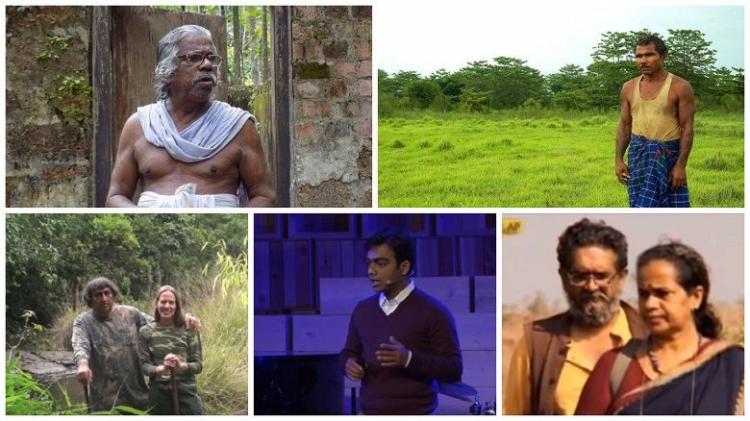
The award-winning Eco-Tree Project based out of Chennai and the backyard forest creating startup  Afforestt of Bengaluru and their efforts to create forests in the urban jungle needs to be lauded on this day celebrating Forests and Sustainable Cities. 

But on the day celebrating the Forests as well as other days we need to give thanks to the many forest makers of India need do our little bit to help the cause. 
(c) The News Minute

 The efforts of these people as well as the natural advantage have helped ensure that India is among the Top Ten Nations in the World with regard to Forest Cover as per the Ministry of Environment, Forest and Climate Change report India State of Forest Report (ISFR) 2017 released last month. 

Overall mankind will benefit once we start valuing the tree and forests - transitioning from a hydrocarbon driven economy to a carbohydrate driven one would enable more equitable development, as mentioned by Dr. Ranil Senanayika, Sri Lankan proponent and pioneer of Analog Forestry at the 5th Asia Pacific Adaptation Network Forum in Colombo in October 2016.


More information on the benefits of urban forests in cities @ http://www.un.org/en/events/forestsday/

Mankind is selfish so let's put a price to our trees and forests: think of the value of the tree and forests - considering the cost of an oxygen cylinder - A human consumes oxygen worth Rs. 130,000 per day so the value of the oxygen producing plants, trees and forests are priceless. Save Forests!