Showing posts with label SDG11. Show all posts

Saturday, 11 December 2021

South Asian Perspectives on Sustainable Mountain Tourism: International Mountain Day 2021

The hills are calling but when we answer the call sometimes we find the popular mountain tourist destinations full of trash and traffic. Invariably what's popular in these places are big-chain hotels, big-chain souvenir shops and super-markets. As a result a very small fraction of the tourist money trickles into the pocket of locals who bear the tax burden and inconvenience of living in a congested and trashed tourist mountain haven. Thus, in this gap between COVID waves as people flock to mountain escapes is an apt time for the theme of International Mountain Day 2021 to be Sustainable Mountain Tourism.


 So what is Sustainable Tourism?

Sustainable tourism is defined by the UN Environment Program and UN World Tourism Organization as “tourism that takes full account of its current and future economic, social and environmental impacts, addressing the needs of visitors, the industry, the environment and host communities.” 

So how is this operationalized: Stay in local homestays and non-chain locals-owned hotels, buy souvenirs and local produce from the locals and commit to be a responsible visitor. See more on eco-tourism in this article by Ramala.

When we ensure sustainable tourism in the hills, hill stations and mountain-top tourist paradises, we ensure that leave behind only footprints and pleasant memories with their mountain hosts. This ensures that tourism there achieves a range of sustainable development goals (SDGs): 

SDG8 - Sustainable livelihoods enshrined in the  principles of sustainable tourism ensures Decent Work and Economic Growth in the mountain destination. 

SDG11 - the organization of a Sustainable Community supported by sustainable livelihoods generated by responsibly used tourist money.  

SDG12 - Responsible Consumption and Production of resources in the hill-top tourist draw. 
SDG13 & SDG 15 - Through Sustainable Mountain Tourism which puts protecting the tourist spot's environment and making a conscious effort to reduce the ecological and carbon footprint of the presence of tourists there even as the tourist money flows into local pockets and institutions that sustainably develop, protect and restore the sensitive mountain ecosystem achieves both Climate Action and champions Life on Land.


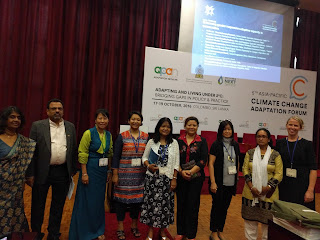
Former mountaineer, Ms. Tshering Uden Bhutia is a community leader from West Sikkim. She works with the community organization Khangchendzonga Conservation Committee (KCC) to promote eco-tourism in Sikkim, particularly in the trails leading up to Kanchenjunga, the third highest peak in the world and sacred to the both countries it straddles (Nepal and Sikkim in India). Uden and KCC have promoted Sustainable Mountain Tourism in Sikkim which has helped build resilience and create a sustainable community with sustainable livelihoods in the Himalayan state through a wide variety of activities. Uden has represented her state and organization in many fora but the APAN forum (5th Asia Pacific Climate Change Adaptation Forum in Colombo, Sri Lanka, October 17 to 19, 2016) was her first international venture.  She part of the panel in the parallel session “Enhancing Gender Responsive Adaptive Capacity in Communities” on the last day of APAN 2016.

  The social entrepreneur from Yuksam in West Sikkim, Uden has been involved with sustainable livelihood projects and waste management for over twenty years and her efforts are embody the core principles of Sustainable Mountain Tourism, the theme for International Mountain Day 2021 (December 11) . Her love of the mountains translated into community leadership. She hails from the Himalayan state of Sikkim, in a district at the base of the sacred and majestic Kanchenjunga. And leads the Khangchendzonga Conservation Committee (KCC) which “comprises of community representatives, community based organization and other key stakeholders highly committed toward nature conservation.”

In her childhood Uden’s family tearoom served varieties of dishes using Maggi 2-Minute Noodles. And over her lifetime she witnessed the noodle wrappers take over her home. While climbing the peaks as well the debris consisted of food wrappers. Instant noodles and other instant foods cooked with just hot water are a great convenience for mountaineers and for people cooking in the open.  It is used everywhere and is the fast food of choice as it is both easy to carry and easy to cook. Yet the plastic wrappers leaves a non-biodegradable wake behind tourists, trekkers, and mountaineers for only a fraction committed to “leaving behind only footprints.”

Since 1997, as a personal contribution to reducing waste she decided to avoid Maggi products and the like.  She made her own instant noodles and carried it in reusable containers that she brought back, without littering in her wake. She opted for fruits and nuts to processed foods and though it was hard and sometimes expensive – and literally extra baggage, she developed and fully committed to the pro-planet habit.  For as the KCC website puts it,

Conservation cannot happen with an empty stomach, hence KCC strongly believes in providing livelihood support to mountain people and facilitating them for alternative livelihood with minimum impact on nature and the rich culture, thus creating a win win situation among nature and its people.

KCC conserves natural and cultural resources through skill development programs, micro planning, awareness campaigns, monitoring of natural resources as well as by advocating for appropriate policy changes. Through KCC and other community level activities Uden now has more waste management, reducing, reusing and recycling programmes. The habit turned into a job creator and in turn she and other community leaders build pro-planet skills and capacities through training, exposure and other participatory means.

Source: http://www.redelephantfoundation.org/2017/01/being-pro-planet-taking-personal.html
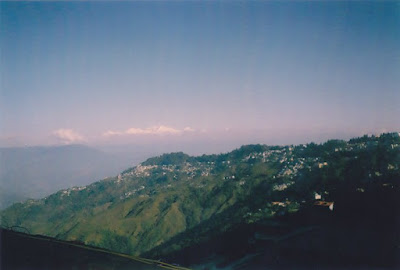
View of the snowy peaks including Kanchanjenga from the hill-station Darjeeling, West Bengal 2010 (My Mum's photography).  


Coming from a coastal tropical metropolis (Chennai, Tamil Nadu, South India) I travel to mountains to experience a different ecosystem to my usual urban, coastal and hot one with limited wildlife and biodiversity. I also heed the call of the mountains to experience the beauty of the night skies, the thrill of experiencing snow fall and finding a cozy rest stop in the cold clime and enjoy the famed hospitality of communities from hills and their unique and delicious cuisine. For this reason I prefer homestays, engaging local guides to take us to the tourist spots and the little-known pristine spots teeming with all things wild before shopping and eating in local markets and eateries for an authentic experience that also puts my money in the hands of the hill-station's residents.

These are Indian perspectives, I asked a few people in the hospitality and travel sectors in hill stations in other parts of South Asia and they came through with great insights:
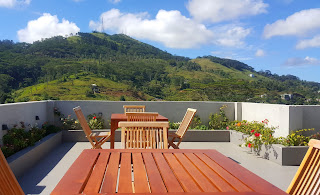
View from the rooftop, Idyllic Vista (indeed!), Kandy, Sri Lanka

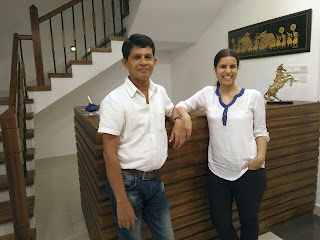
Devika Fernando, Author & Innkeeper along with her husband Thushara Fernando from Kandy, Sri Lanka had this to share: 

“Kandy is a city surrounded by hills and mountains. Naturally, that means some guests want to go on hikes. Our inn is situated high up in Hanthana so it's a good starting point. Sustainable tourism in the mountains is something that's close to our hearts. My husband and I always advise our guests not to leave any trace of themselves behind - that especially means no littering! Not taking anything from the ecosystem back with them is just as important. Nature should be observed, not disturbed. Staying on the hiking trails is advisable too, for the tourists' safety as much as for all the animals that call these misty mountains their home.”
*
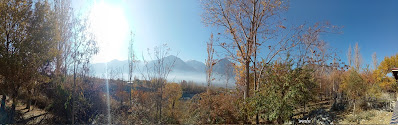
View from the window, Gilgit-Baltistan

Syedda Ramla the mompreneur from Gilgit-Baltistan, quoted on her eco-tourism article before had this to share: 

"My name is Syedda Ramla and I own BetterBonds, an online shop for 'Himalayan Medixine' which is my modern take on traditional healing with plants, crystals and honey. I make gemstones jewelry and herbal tea and balms. We are at http://instagram.com/betterbonds. Hit us up!

 I migrated to Gilgit-Baltistan from the coastal Karachi in 2013. What pulled me was the quest to experience and observe an earthy, handmade life that was ecologically integrated. I was fascinated by handmade homes, a connection with cattle and produce, a high dependence on seasonality, and the opening of the Self to the elements. I admit, I also love the thrill of living on the edge; I love what it demands of our person and psyche. I passed some tests and failed others.

 For those who are on such 'soulular' quests, this region can provide one of the last few such remaining opportunities on our otherwise rapidly modernizing and gentrified Earth. But I warn you, this place, too, is changing and that is why we need more of those travelers who think in sustainable and earthy ways. That to me is the true potential of the place.

 Unfortunately, unlike the rest of Himalayan nations and regions, Pakistan is still not seeing this opportunity fully or comprehending the nuances of it. We still have a police state approach, we still give tourists the stink eye and ask: "Why are you here? Why are you traveling? Why aren't you back home with your Momma?" I have seen this too many times to be comfortable in pretending it is otherwise.

 On the other hand, Nepal and India for instance wholly grabbed the hippie movement, for instance, by the horns and steered it fairly usefully. As a result a whole counterculture was born, and tourists are attracted in hordes to those regions. We are still behind. There is favoritism for Whites. Our local tourists are neither informed nor regulated.

 I would wholly advocate a restricted tourism approach to protect ecology: Issue a number of passes per year, and make economy options available. Brief people well. Grab the moment and speak to them about environmental concerns, make it mandatory to run a drill on each bus' communication system, make it pleasing. Why not? This is entirely possible.

 Finally, folks, come here for Autumn and come well-prepared. The goldens, browns, reds, last greens on the trees are lovely. The angles of sunlight are ephemeral as seen in the above picture from my home a few days ago (December 2021)."

So remember, next time you heed the call of the mountains, tread lightly, ecologically speaking and travel responsibly and leave the paradise, if not better than you found it at least as wonderful as it was when you got there!

Saturday, 25 September 2021

Act on SDGs: Turn It Around

 Six years into the Sustainable Development Regime, on this the Global Week to #Act4SDGs, I, Raakhee Suryaprakash from Chennai, India, am using the platforms of my initiatives Sunshine Millennium and Re.Plastic  (https://www.facebook.com/Re.Plastic10) to showcase and #Amplify @SDGActions from around the world. I am communicating about and sharing #SDG best practices to #TurnItAround on Action on the Sustainable Development Goals. 

Through my initiative Sunshine Millennium, I amplify successes in the fields of #SDG7 - Affordable & Clean Energy, #SDG13 - Climate Action, #SDG11 - Sustainable Cities & Communities, #SDG6 - Clean Water & Sanitation as well as the SDGs 14 & 15 -#LifeBelowWater & #LifeOnLand - basically biodiversity conservation.

With my initiative  REplastic I amplify #SDG8 #SDG9 & #SDG12 for I believe responsible plastic waste management and controlling plastic production combines aspects of #innovation & responsible consumption and production while yielding #DecentWork and #EconomicGrowth.  


Tuesday, 2 February 2021

Wetlands & Water: World Wetlands Day 2021

 Wetlands sustain life. Wetlands protect life. The day of adoption of Ramsar Convention protecting wetlands, February 2nd, has since been celebrated as " World Wetlands Day." The 2021 theme is Water and Wetlands both vital for survival and both used up as urban centres sprawl to take up what used to be vital wetlands that have sustained life and livelihoods for centuries.


According to the Ramsar Convention, the inclusive definition of Wetlands is as follows:

“…wetlands are areas of marsh, fen, peatland or water, whether natural or artificial, permanent or temporary, with water that is static or flowing, fresh, brackish or salt, including areas of marine water the depth of which at low tide does not exceed six metres."

This inclusive definition is important in the quest to protect what's left of the wetlands - these teeming biodiversity hotspots because so many cities - metros and capitals have been built on or around what used to be massive wetland systems. 

Dismissed as "swamps," drained of water and later pumped full of concrete our "urban planners" of the past have created water scarce cities that are ironically flood prone as well. As the cooling water, flora and fauna of the marshes were replaced by concrete cities urban heat islands flourished negating the wetland carbon sinks and adding to global warming and the climate emergency.


Last year, the Ramsar-Bonn connect was highlighted just before the pandemic ground the world world to a halt, at the 13th conference of parties to the Bonn Convention of migratory species of wild animals, hosted in India: 10 wetlands across India were designated Ramsar sites or "wetland sites of international importance."

Migratory birds in salt marshes - Rann of Kutch

Hopefully as the powers that be commit to sustainable development, our wetlands will be protected and future cities will all be sustainable cities not just "smart cities." Wetlands and water are inseparable and if we are to tackle the climate crisis we need to put protecting wetlands at the heart of climate action. 

Wetlands are water reservoirs, natural flood prevention, vital carbon sinks as well as sustaining a vast array of biodiversity. Urbanization is an inevitable consequence of modernization but if mankind is to survive our cities shouldn't grow at the cost of wetlands. Another consequence of urbanization and modernization is the growing plastic crisis - plastic waste is as dangerous to the health and survival of wetlands as marine plastic is to oceans. But, there are many efforts underway to remove plastics and landfills from our wetlands as well as efforts to stop plastic from ending up in wetlands in the first place. 

How wetlands manage water: Wisconsisn

Wetlands are the final defense against the intensified flood-drought cycle caused by climate change. Cities running out of water is an ever-recurring crisis across the planet and wetlands, as shown in Kolkata and Kochi, can be vital in ensuring water security and SDG 6 (Clean water and sanitation) in cities. After the Chennai Floods back in 2015 and the Vardah Cyclone the following year, many people saw first hand how fast the Pallikarnai Marsh absorbed flood waters, yet we continue to encroach upon it with concrete and garbage to expand this already water-starved flood-prone city of Chennai. 


Protecting wetlands is ensuring water security and water security spells human security. Thus it is in the interest of mankind to SAVE THE WETLANDS!